2025-12-16 Daily Challenge
Today I have done leetcode's December LeetCoding Challenge with cpp.
December LeetCoding Challenge 16
Description
Maximum Profit from Trading Stocks with Discounts
You are given an integer n, representing the number of employees in a company. Each employee is assigned a unique ID from 1 to n, and employee 1 is the CEO. You are given two 1-based integer arrays, present and future, each of length n, where:
present[i]represents the current price at which theithemployee can buy a stock today.future[i]represents the expected price at which theithemployee can sell the stock tomorrow.
The company's hierarchy is represented by a 2D integer array hierarchy, where hierarchy[i] = [ui, vi] means that employee ui is the direct boss of employee vi.
Additionally, you have an integer budget representing the total funds available for investment.
However, the company has a discount policy: if an employee's direct boss purchases their own stock, then the employee can buy their stock at half the original price (floor(present[v] / 2)).
Return the maximum profit that can be achieved without exceeding the given budget.
Note:
- You may buy each stock at most once.
- You cannot use any profit earned from future stock prices to fund additional investments and must buy only from
budget.
Example 1:
Input: n = 2, present = [1,2], future = [4,3], hierarchy = [[1,2]], budget = 3
Output: 5
Explanation:

- Employee 1 buys the stock at price 1 and earns a profit of
4 - 1 = 3. - Since Employee 1 is the direct boss of Employee 2, Employee 2 gets a discounted price of
floor(2 / 2) = 1. - Employee 2 buys the stock at price 1 and earns a profit of
3 - 1 = 2. - The total buying cost is
1 + 1 = 2 <= budget. Thus, the maximum total profit achieved is3 + 2 = 5.
Example 2:
Input: n = 2, present = [3,4], future = [5,8], hierarchy = [[1,2]], budget = 4
Output: 4
Explanation:
- Employee 2 buys the stock at price 4 and earns a profit of
8 - 4 = 4. - Since both employees cannot buy together, the maximum profit is 4.
Example 3:
Input: n = 3, present = [4,6,8], future = [7,9,11], hierarchy = [[1,2],[1,3]], budget = 10
Output: 10
Explanation:
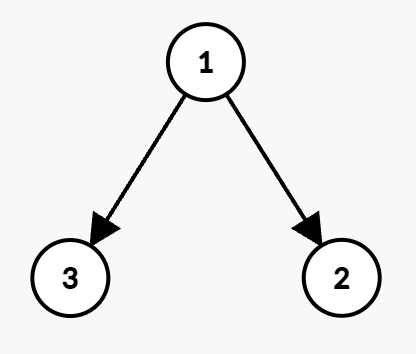
- Employee 1 buys the stock at price 4 and earns a profit of
7 - 4 = 3. - Employee 3 would get a discounted price of
floor(8 / 2) = 4and earns a profit of11 - 4 = 7. - Employee 1 and Employee 3 buy their stocks at a total cost of
4 + 4 = 8 <= budget. Thus, the maximum total profit achieved is3 + 7 = 10.
Example 4:
Input: n = 3, present = [5,2,3], future = [8,5,6], hierarchy = [[1,2],[2,3]], budget = 7
Output: 12
Explanation:
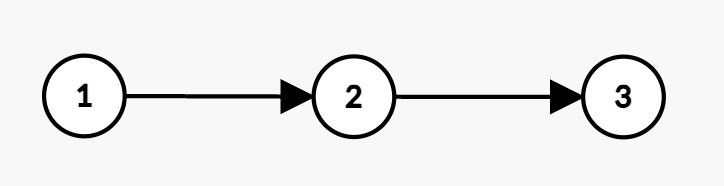
- Employee 1 buys the stock at price 5 and earns a profit of
8 - 5 = 3. - Employee 2 would get a discounted price of
floor(2 / 2) = 1and earns a profit of5 - 1 = 4. - Employee 3 would get a discounted price of
floor(3 / 2) = 1and earns a profit of6 - 1 = 5. - The total cost becomes
5 + 1 + 1 = 7 <= budget. Thus, the maximum total profit achieved is3 + 4 + 5 = 12.
Constraints:
1 <= n <= 160present.length, future.length == n1 <= present[i], future[i] <= 50hierarchy.length == n - 1hierarchy[i] == [ui, vi]1 <= ui, vi <= nui != vi1 <= budget <= 160- There are no duplicate edges.
- Employee 1 is the direct or indirect boss of every employee.
- The input graph
hierarchyis guaranteed to have no cycles.
Solution
class Solution {
  static constexpr int N = 161;
  vector<vector<int>> children;
  int DP[N][2][2][N] = {};
  vector<bool> visit;
  int profit[N][2] = {};
  void init(int n, const vector<vector<int>>& hierarchy) {
    children.resize(n + 2);
    for(const auto &e : hierarchy) {
      children[e[0] - 1].push_back(e[1] - 1);
    }
    visit.resize(n * 4);
  }

  void dfs(
    int current,
    bool bossBuy,
    bool buy,
    int budget,
    const vector<int> &present
  ) {
    if(visit[(current << 2) | (bossBuy << 1) | buy]) return;
    visit[(current << 2) | (bossBuy << 1) | buy] = true;

    int *cache = DP[current][bossBuy][buy];
    fill(cache, cache + budget + 1, INT_MIN);

    int cost = buy ? (bossBuy ? present[current] / 2 : present[current]) : 0;
    if(cost <= budget) {
      cache[cost] = buy ? profit[current][bossBuy] : 0;
    }
    vector<int> cur(cache, cache + budget + 1);
    vector<int> merged(budget + 1);

    for(auto child : children[current]) {
      dfs(child, buy, true, budget, present);
      dfs(child, false, false, budget, present);

      int *take = DP[child][buy][true];
      int *skip = DP[child][false][false];

      fill(merged.begin(), merged.end(), INT_MIN);

      for(int b = 0; b <= budget; ++b) {
        if(cur[b] == INT_MIN) continue;
        for(int x = 0; b + x <= budget; ++ x) {
          int best = max(take[x], skip[x]);
          if(best == INT_MIN) continue;
          merged[b + x] = max(merged[b + x], cur[b] + best);
        }
      }
      cur = merged;
    }
    for(int i = 0; i <= budget; ++i) {
      cache[i] = cur[i];
    }
  }
public:
  int maxProfit(int n, vector<int>& present, vector<int>& future, vector<vector<int>>& hierarchy, int budget) {
    for(int i = 0; i < n; ++i) {
      profit[i][0] = future[i] - present[i];
      profit[i][1] = future[i] - present[i] / 2;
    }
    init(n, hierarchy);

    dfs(0, false, false, budget, present);
    dfs(0, false, true, budget, present);

    int answer = 0;
    for(int b = 0; b <= budget; ++b) {
      answer = max({answer, DP[0][0][0][b], DP[0][0][1][b]});
    }
    answer = max(answer, *max_element(DP[0][0][0], DP[0][0][1] + budget + 1));
    return answer;
  }
};

// Accepted
// 790/790 cases passed (109 ms)
// Your runtime beats 93.75 % of cpp submissions
// Your memory usage beats 76.39 % of cpp submissions (104.2 MB)